 By
By 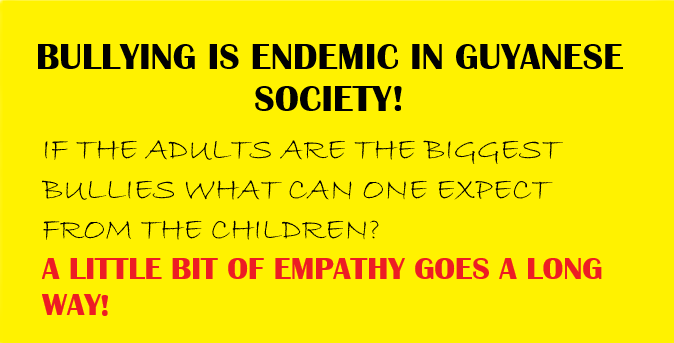
Every time, I read about some initiative or the other regarding bullying and mental health, I scoff. I see the so-called efforts as nothing more than window dressing. The vast majority of Guyanese I have encountered in my life lack empathy for others. And I believe, find pleasure in the suffering of others. The term ‘Schadenfreude’ is applicable to Guyanese society.
Bullying in public schools across the country is once again in the spotlight mainly due to the incidents being broadcasted and shared on social media. However, nothing ever really changes and it’s like putting a bandage that is going to drop off 10 minutes later, on a festering wound. If grown adults constantly bully others what else can one expect from children? Accountability, compassion and empathy for others are missing from Guyanese society. Can these things be taught?
For real change to occur, empathy is necessary
At one time, Guyana had the highest suicide rate in the world, and it still ranks at the top and probably still occupies first place since there is notable underreporting. Instead of focusing on why people feel the need to take their lives in the first place, the reaction to this ‘bad publicity’ was less media coverage for those who committed suicide and more emphasis on restricting access to the means used to commit these acts such as pesticides.
However, these measures do not address the root cause of the problem. Furthermore, if one is determined to take one’s life then there are many unrestricted ways to commit the act and hiding the problem doesn’t make it go away.
This post is based on my own experiences and observations as someone who has lived her entire life (except for less than 2 years abroad) in Guyana.
My experience with bullying
When I was 12 years old and in Form 2 (Grade 8), students and even teachers started bullying me. I got up to mischief and in a childish effort – I was a twelve-year-old child who thought like a child! – to save myself from a beating, I sipped some kerosene from a spoon then lied about how much I’d taken after I was cornered later. I thought that I could get my parent to feel sorry for me and not tell the other parent about what I’d done. The idea came to me because a neighbour’s child had accidentally drunk kerosene and I observed everyone making a fuss over him and treating him ‘special’. I wrote about this time in my life (https://lifeingy.com/my-experience-with-bullying/).
From the moment I returned to school I was bullied. I was called names such as ‘kero’ and ‘stove’ by students and even some male teachers. My story got twisted to satisfy the bullies. It became one where I’d attempted suicide over a boy (although the identity of the boy was never revealed to me). My plan was not to commit suicide nor was the reason for the act due to a boy but that was the prevailing assumption probably because the truth was too boring.
Reaction from the school
I was called names and students even made up ‘songs’ to bully me which they would loudly sing when I walked by. Boys in the upper levels were the main culprits and teachers were aware of what was happening yet I was never referred to a counsellor or the matter addressed by teachers until I was about to enter Grade 11. The then HM spoke to us at an assembly about bullying and that helped to some extent; the name calling reduced.
For years, I was emotionally affected at school by the bullying and my way of coping was to pretend (or maybe it was real, I can’t remember) to be ill. I’d faint and someone would go to the school to get me. I remember even being carried out by my parent’s cousin. I think my body reacted that way because I wanted to stay home but that didn’t work.
Although, all of this was happening, nothing was never addressed. My parents and teachers never asked me ‘Why?’. Sounds unbelievable, but that is exactly what happened. Guyanese believe that by ignoring or avoiding an issue it would magically go away or resolve on its own and I still observe this behaviour up to now. Plus, maybe they don’t want to get involved or have to think too deeply; it’s better to be shallow and indulge in stuff such as gossiping and labelling rather than have to see someone as a person with real feelings.
The knife incident
One of the leaders of the bullying pack, an older boy (now man), Bramanand Seemangal decided to up the ante from his loud ‘singing’. He would join the same bus I got into after dismissal and make a lot of sexual remarks about me. This was to make me more uncomfortable plus further embarrass me in front of other students. I remember he said that he was having ‘wet dreams’ about me. And at the time, I couldn’t speak to nobody about this. Teachers were unapproachable and I couldn’t talk to my parents about anything. Everything was off topic especially things of a sexual nature. There was absolutely no communication. I still wonder why they decided to have children in the first place but I’d leave that for a future post and my aim would not be to embarrass but talk about the lack of communication in Indo-Guyanese families. Plus, their relatives never commented or asked me about my so-called suicide attempt so it’s not a limited issue.
Well, after one particularly embarrassing afternoon in the bus I came home and debated in my mind how to handle the situation. I decided to take a butter knife from the kitchen to threaten the bully the following day. I thought that would deter him from embarrassing me further. However, I told my classmates about what I planned to do soon after arriving at school. They told the teacher and without asking me anything about the matter I was told to report to the Education Department the following day with my parent.
My parent and I went. A male officer spoke with me and what I remember about him was that he was polite, friendly and understanding. I felt so comfortable talking to him that I asked to speak to him alone. I felt embarrassed talking about the issue with my parent in the room, so he waited outside. At the end of the conversation, I was told to return to school the next day. I don’t know what was said to my parent and the HM but I wasn’t suspended. The next day, when the HM saw me she commented that I had ‘contacts’ at the dept! Although, it never got to the point of me threatening the bully with the knife, he was seen as the victim.
Reaction from teachers in the school
All of this happened at Annandale Secondary School. At the time, the school didn’t have counsellors and no teacher (in my case) took on the responsibility of ‘talking’ to so-called troubled or otherwise affected students but all knew that I was being bullied because the students would loudly call me kero, stove or other related words whenever they saw me and of course, there was the singing crew.
In fact, I was even called these names by some male teachers and labelled as someone with ‘psychiatric’ issues probably due to my reaction to the bullying with included fainting. For instance, in 5th Form I was forced to complain to the HM about a teacher and after, he no longer came to our class. He never even taught me yet was bullying me due to his perceptions about me. I was in the Science Stream and he was a business teacher (Mr. N.S) but when our class teacher was on leave, he marked the register. During this short period he picked on me by asking if I was stupid, an idiot etc., if I didn’t respond loud enough or did something that gave him the excuse to indulge in his name calling. It got so bad that my classmates were the ones who actually urged me to complain to the HM, Ms. Singh about him. Our science class was the smallest and for whatever reason we were more empathetic and understanding towards each other. I was never bullied by them and some of us still keep in contact.
After school reaction from teachers
Years later, I returned to the school as a grown woman for a particular purpose and I met a few teachers who were teaching when I was a student there. One stared at me (the DHM) but I couldn’t remember him so I asked if he knew me and he said that he taught me when I was in the lower forms. Then he said that I had psychiatric issues with a smirk on his face. He wasn’t a health worker in the field but he ‘diagnosed’ me as having psychiatric issues.
The HM, Mr. Persaud said that he didn’t know that I wanted to be in the education field so I told him about my medical school ordeal. Then he said that it’s a good thing that didn’t work out or else I could have killed the patients! What a nasty, distasteful thing to say! In Guyanese patriarchal society lots of men feel that they can say whatever they feel like saying to women. On a side note though, I wanted to be a pathologist or epidemiologist.
These educated teachers who taught me when I was a student felt comfortable saying those things to me although, apart from our student-teacher/professional interactions we didn’t know each other. Basically, they perceived me a certain way when I was a student (child) and carried that same bias which they chose to apply to the adult me.
Apart from those interactions a few other teachers (males) called me names such as ‘kero’ behind my back, whenever they saw me although we were all grown adults and the incident happened decades ago!
Community and societal reaction
I continued to be bullied (name calling) long after high school and even presently by some. I was bullied at university because some students from my school and community went on to university and told others about the names they’d call me.
And I was bullied in the neighbourhood by adults. One time, a middle-aged woman with some children crowded around her, asked if I am the person they call ‘kero’ when I visited her house with others to conduct registration. Her intention was to belittle me although we didn’t know each other personally; this is how prevalent and audacious bullying is.
Throughout the years, nobody never asked me about what exactly happened nor did I receive any form of counselling/therapy. In fact, in the society there was and still is, great stigma attached to these forms of treatment and it is seen as something reserved for ‘mad people’ (their label).
On the job
Workplace bullying is a whole other topic but regarding this particular incident in my childhood, it reared its head again through my students. For instance, at my former workplace an older male student started calling me Kero, and when I confronted him he said that his father told him that I drank kerosene and that’s what they call me. And recently, at my present workplace, a Grade 7 female student approached me after class and said that her father, K. Jailal (an employee of the MoE) told her that he knows me and that I drank poison for a boy.
This is how many grown men and women in Guyana, regardless of educational background and age behave. They gossiped (technically speaking, Slander) about me with their children and influenced them to be disrespectful to me although I was/am their teacher.
On the road
I’d be walking on the public road and minding my own business when out of nowhere a grown Guyanese man (most of the time), with a wife and children most likely, would shout ‘Kero’ behind my back! Once, I turned around with my phone to snap a photo of the bully and he felt more offended by my actions. He literally started following me with an angry expression on his face; I had to duck into a store. He felt it was OK to bully me and expected me to do nothing about it…a grown man bullying a woman. This is typical. Another one (HC 9310) did the same when he saw me going to national library and when I turned around he hurriedly pressed the accelerator.
What it boils down to
There is an overall lack of empathy in Guyanese society. Many persons here feed off of the suffering of others. When I was 12 years old, it was assumed that I tried to commit suicide. Instead of getting sympathy, understanding and help I got bullied and still continue to be bullied. It’s like these pathetic adults feel like it’s their right to punish me for something which doesn’t even have nothing to do with them whether true or not!
Many persons have attempted suicide and survived but here, if one survives a suicide attempt (real or not) it’s like they feel its their right to bully you until you successful commit the act.
Bullying in the society
Bullying in Guyana is engrained in the fabric of the society. People who are perceived to be different and/or suffering from mental health issues are bullied.
I have seen others being bullied especially persons from the LGBT community and they get bullied relentlessly. I’ve witnessed students who are perceived as being too effeminate or to be gays/lesbians being bullied by students and even teachers. Many end up being disowned by their families and a few that I personally know left Guyana to live in more tolerant countries.
One time, I observed a woman wearing a Kimar, being bullied by a vendor on the pavement. He asked her if she had a bomb under her dress and other nonsense along that line; she didn’t look or speak to him but kept walking. The stories are countless and one is constantly bombarded by it on social media but what it all points to is endemic bullying that is part of the cultural mindset of Guyanese.
Tolerance, understanding, compassion and empathy
Would people bully and abuse others if they had compassion and empathy for them? Many adults in Guyana bully others, it’s not a school yard issue alone. Children see their parents bullying others and they then feel that it’s right to engage in the same behaviour. Bullying is far more pervasive and localised at the same time. The adults need to change their behaviour first if change is to occur with the children. Many are intolerant, lack compassion and empathy for others and the way their children behave is a reflection of themselves.


